
One pizza, one valve, one subscription: how Salesforce Revenue Cloud actually works
Most Revenue Cloud explainers drown you in object diagrams. This one starts at a pizza counter - because a pizza order contains every single concept in quote-to-cash. Then we take the same model into a manufacturing plant and a SaaS business.
Ask three people in the same company where a deal stands and you will get three answers. Sales quotes in one system. Finance bills from another. Someone in operations keeps the real truth in a spreadsheet named final_v4_USE_THIS.xlsx. Nobody is lying - they are just reading different books.
Salesforce built Revenue Cloud to close that gap. It puts product catalog, pricing, quoting, contracting, ordering, billing and revenue recognition on one data model, on the core Salesforce platform. One quote line can be traced all the way to the rupee that lands in the bank.
A quick note on naming: The capability launched as Revenue Lifecycle Management in Spring '24, was productised as Revenue Cloud Advanced (RCA) at Dreamforce '24, and folded into the Agentforce family as Agentforce Revenue Management (ARM) at Dreamforce '25. Same architecture, three brand names. These are now native objects on core, not the old managed packages. Legacy Salesforce CPQ has reached end of sale, but existing customers continue to be supported and can renew.
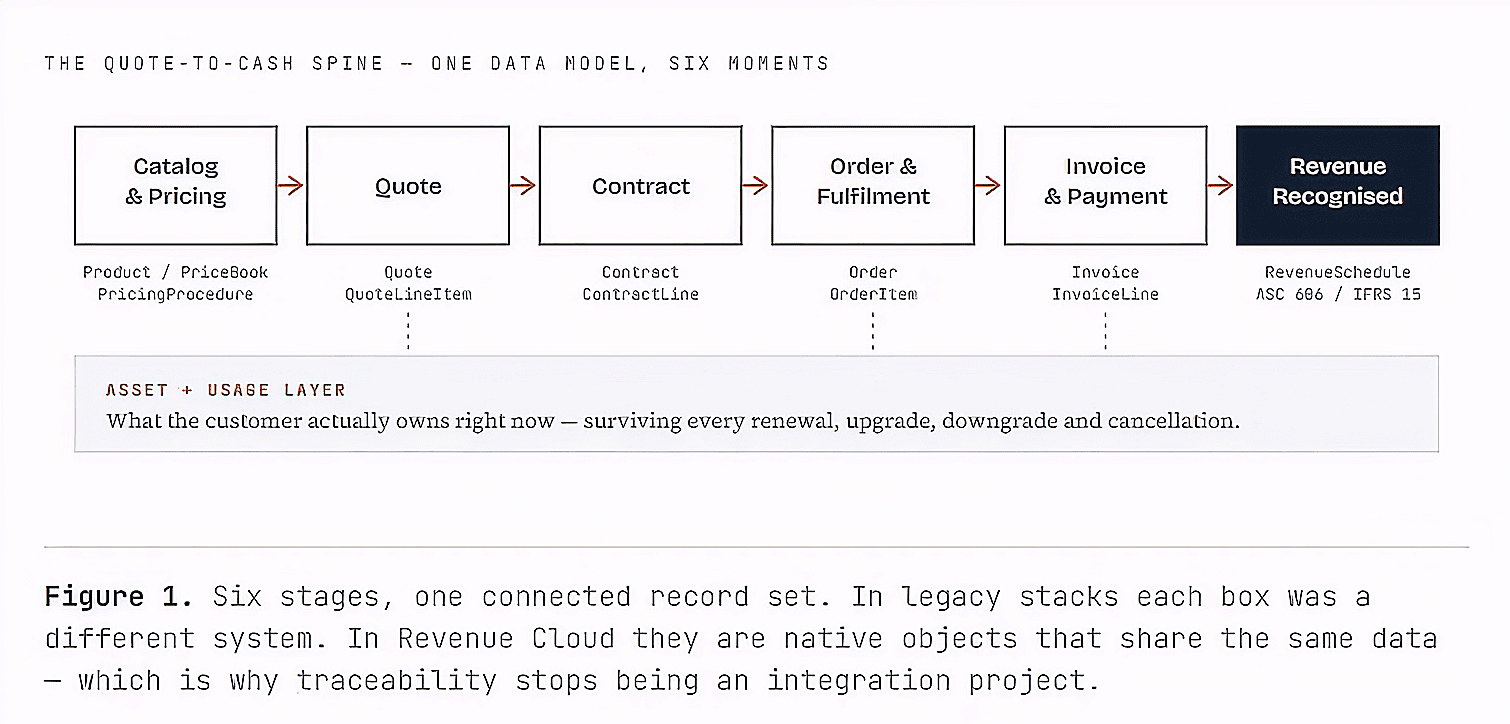
Use case 01 / Retail & Food: The pizza store that explains the whole platform
Scenario: Napoli Slice runs 14 outlets, an app, a phone line and a Pizza Club subscription. Same menu, three ordering channels, one very confused P&L.
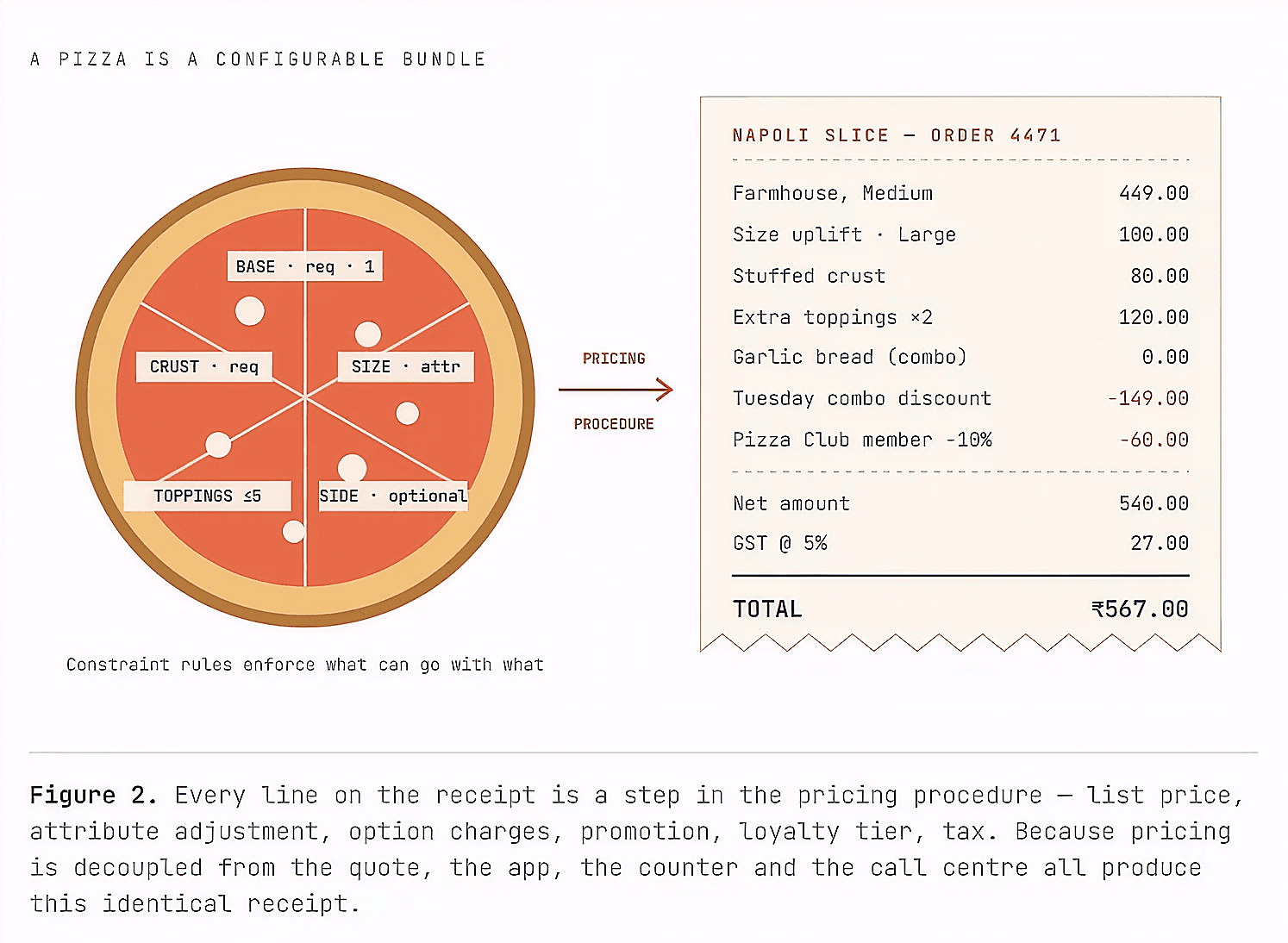
A pizza is not a simple product. It is a configurable bundle with rules, options, attributes and a pricing waterfall - which makes it a perfect scale model of enterprise CPQ.
Catalog and configurator
"Build Your Own" is a bundle. The base is required, pick one. Size is required, pick one. Crust is required, pick one. Toppings are optional, maximum five. Sides and drinks are add-ons. Revenue Cloud's Product Configurator holds those relationships as constraint rules:
- Stuffed crust is only available on Medium and Large.
- Chicken tikka topping is blocked when the Jain preference is selected.
- Choosing the Family Combo auto-includes two sides and a 1.25L drink.
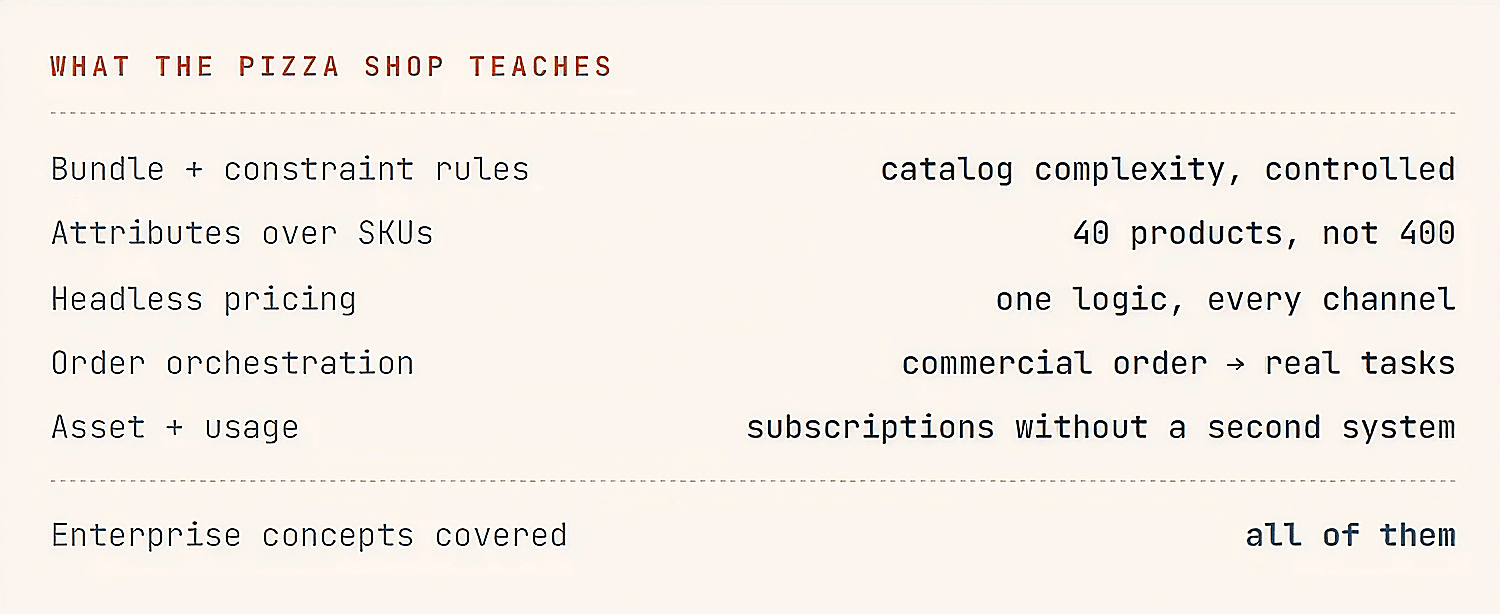
Size is an attribute, not a separate SKU - so the menu stays at 40 products instead of exploding to 400.
Pricing runs headless
This is the biggest architectural change from legacy CPQ. In Revenue Cloud, the Pricing Procedure is decoupled from the quote object. It can run without a quote at all. So the counter POS, the mobile app and the phone-order screen all call the same pricing logic. When marketing changes the Tuesday combo discount, it changes in one place and every channel is correct in the same second.
Then the order becomes a lifecycle
The order is placed, and the Dynamic Revenue Orchestrator decomposes one commercial order into the operational tasks that fulfil it: fire to the kitchen display, box, assign to a rider, close on delivery. The invoice is generated from what was actually delivered.
Now add the Pizza Club - ₹999 a month for two large pizzas. That single change turns a retail transaction into a subscription business:
- Asset. The membership becomes an asset with a recurring billing schedule.
- Amendment. Mid-month upgrade to the Family plan generates a prorated amendment against the same asset.
- Usage. The third pizza in a month is metered and billed as overage.
- Renewal. Month twelve raises a renewal quote automatically.
Use case 02 / Manufacturing: Tracking a quote to the invoice
Scenario: Sanket Precision builds industrial valve assemblies. Quotes live in CPQ, production in the ERP, invoices in the accounting system. When a customer asks "what have you actually billed me for?", four people spend two days finding out.
Manufacturing has a specific pain that SaaS does not: what you quote and what you ship are rarely the same thing on the same day.
Line-level lineage, not document-level guessing
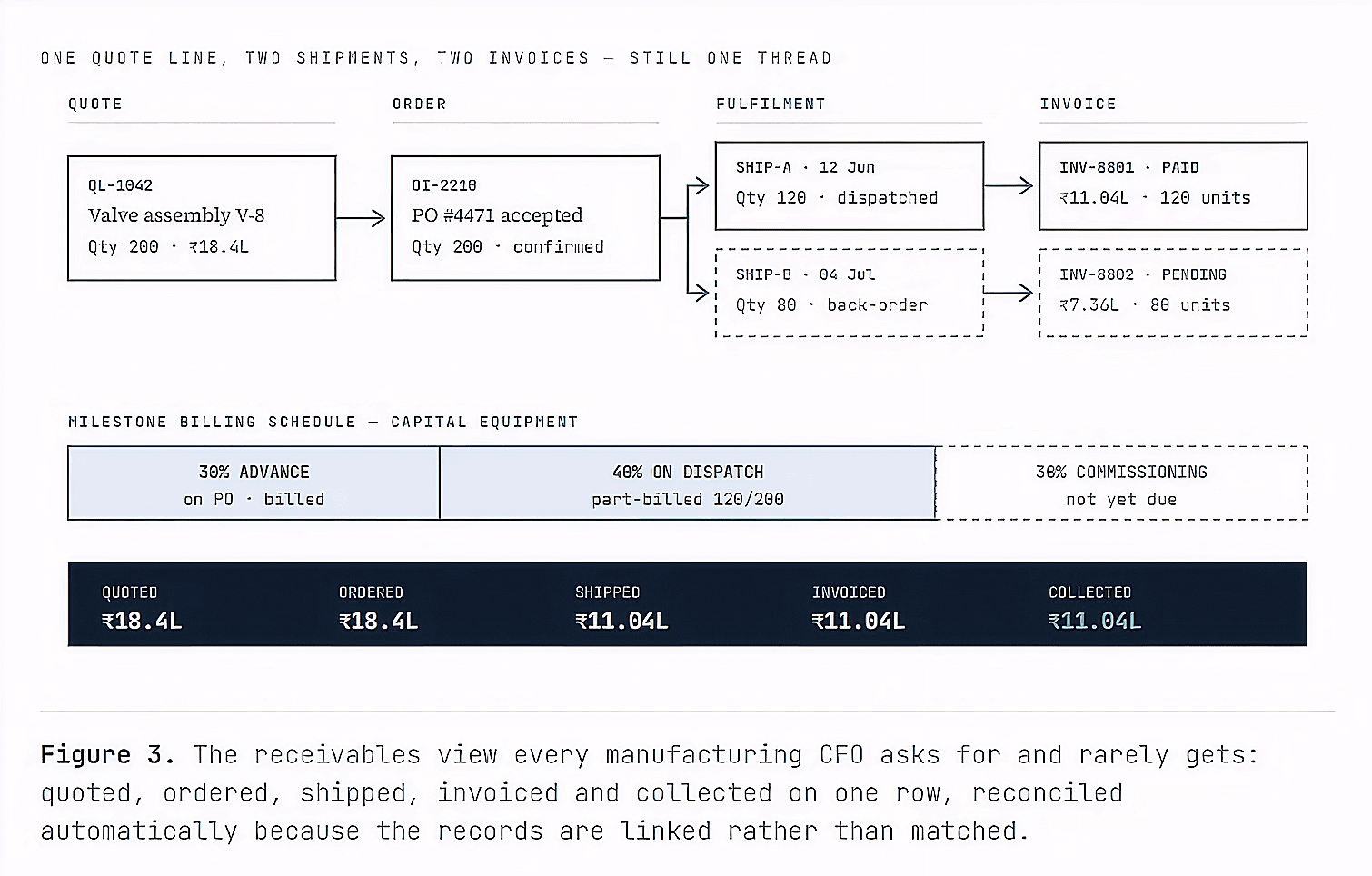
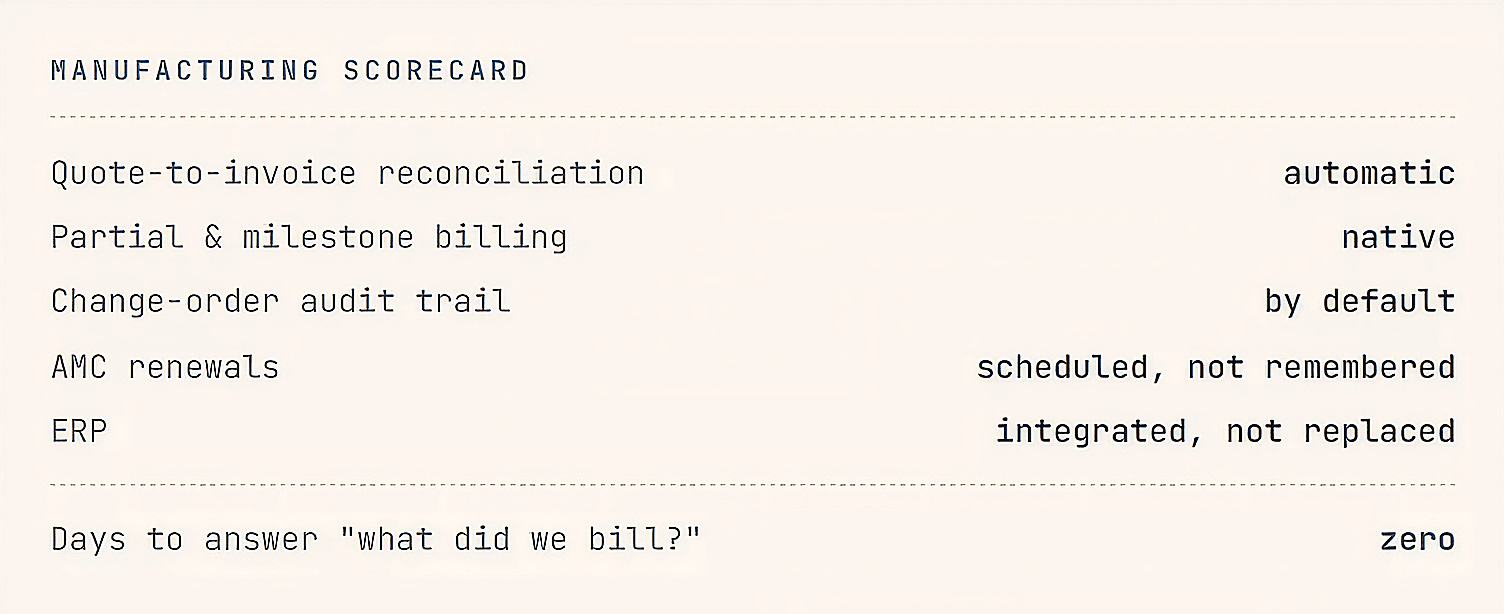
Revenue Cloud fixes this by keeping the identifiers connected. A quote line converts to an order line. The order line is fulfilled - possibly across several shipments. Each fulfilment event drives an invoice line that carries its parent references. The result is a clickable chain: QuoteLine → OrderItem → Fulfilment → InvoiceLine → Payment.
What this changes day to day
- Change orders stop being chaos: A mid-build spec change is an amendment quote that produces a revised order and invoice, retaining previous versions.
- Milestone and progress billing are native: Advance, dispatch, and commissioning tranches are billing schedules on the contract.
- Partial shipments bill correctly: You invoice 120 units and the remaining 80 stay visible as committed-but-unbilled backlog.
- Service contracts renew themselves: The AMC attached to the equipment is an asset with its own renewal date.
One honest caveat about the ERP
Revenue Cloud is not a replacement for your ERP general ledger. Revenue Cloud owns commercial truth (what was quoted, ordered, delivered and billed) and pushes invoice and payment data to the ERP, which remains the system of record for accounting and statutory filing.
Use case 03 / B2B SaaS: Quoting when the deal keeps changing
Scenario: Meridian Analytics sells a seat-based platform with metered API usage, three-year ramp deals and constant mid-term expansion. Finance discovers the real numbers at renewal.
SaaS quoting is hard because the contract is a moving object. A SaaS quote is the opening position in a relationship that will be amended, co-termed, expanded and renewed.
Where Revenue Cloud earns its licence fee
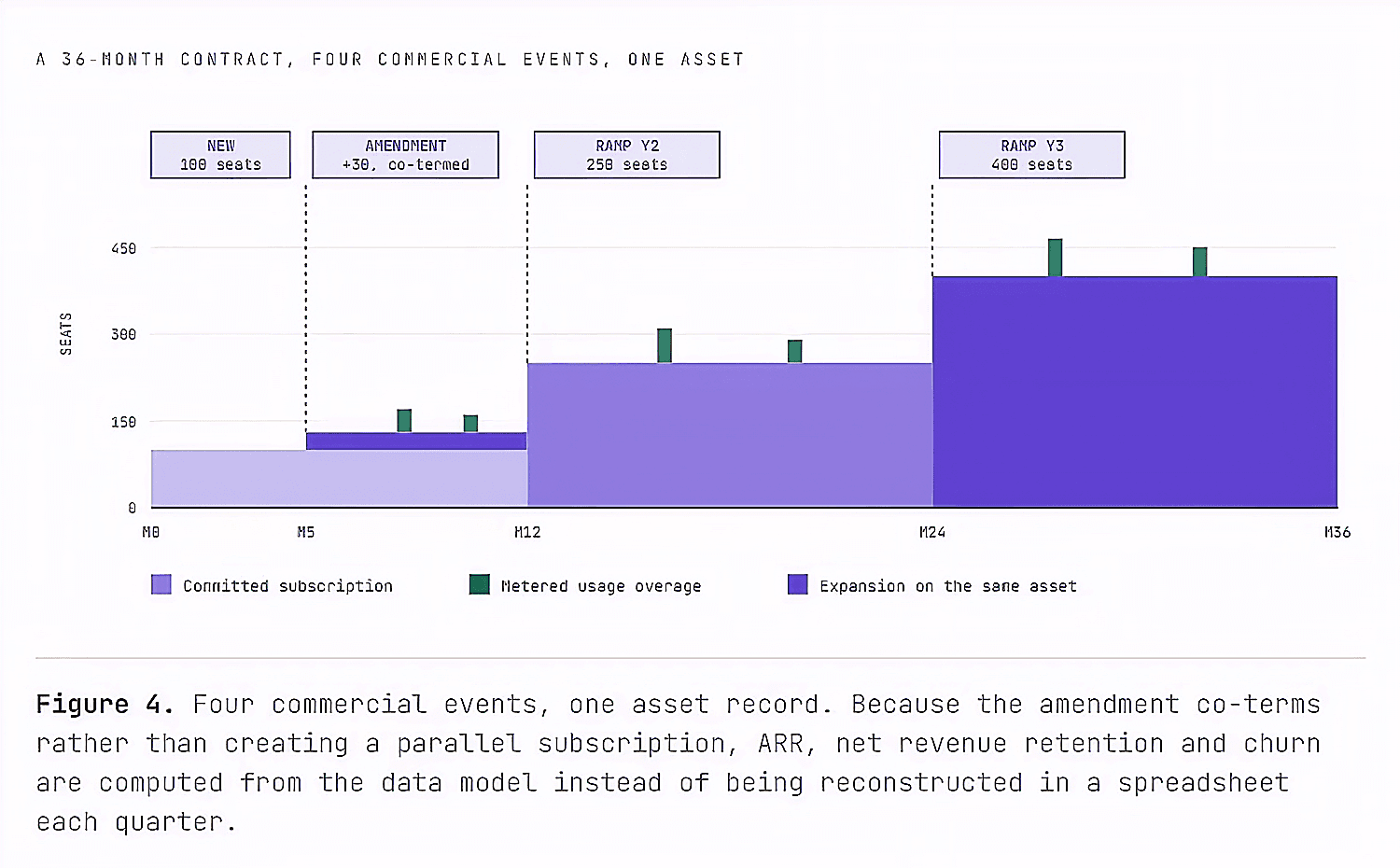
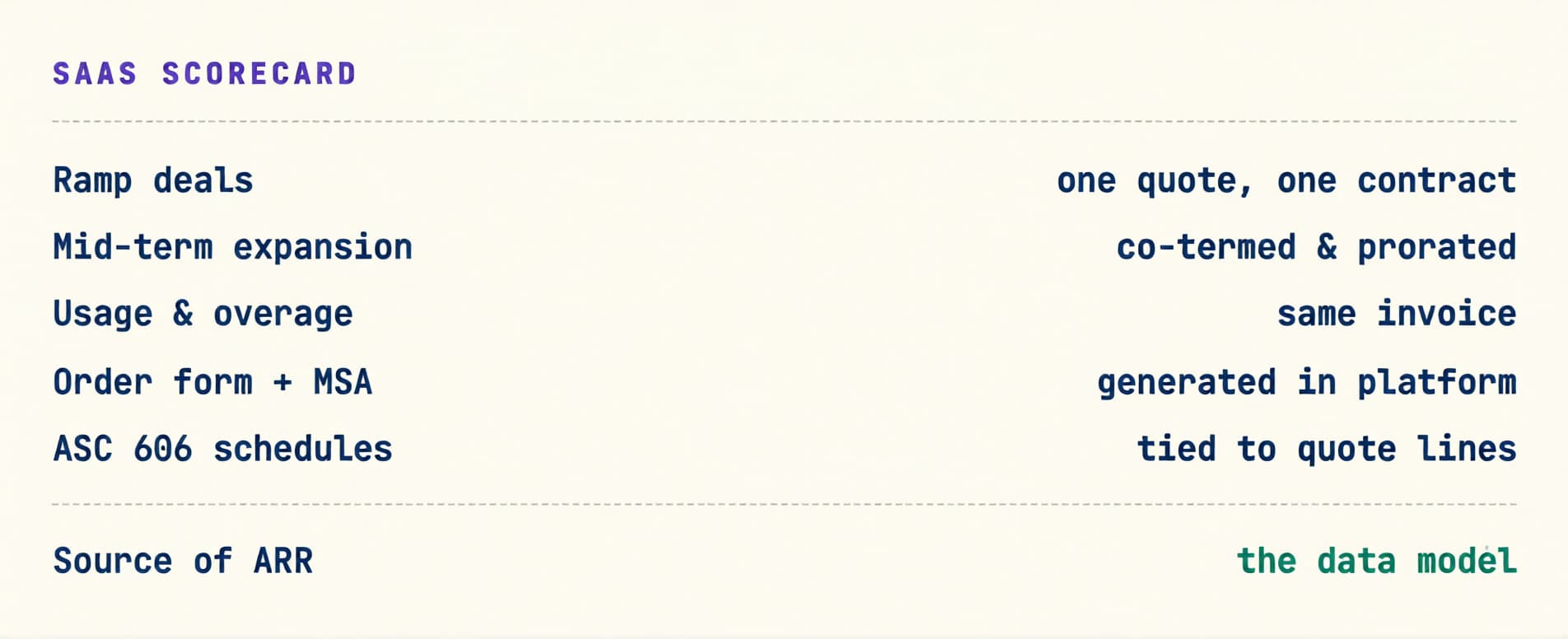
- Ramp deals as first-class quote lines: 100 seats in Y1, 250 in Y2, 400 in Y3, on a single quote.
- Usage pricing: Committed volume with tiered overage rates, feeding the same invoice as the subscription.
- Mid-term amendments that co-term automatically: Thirty seats added in month five are prorated to the existing end date and merged onto the same asset.
- Guided selling and approvals: Discount thresholds route for approval before the quote leaves.
- Revenue recognition: Allocation across performance obligations under ASC 606 / IFRS 15.
In summary: Three industries, one model
A pizza, a valve assembly and a data platform have nothing in common commercially. They have everything in common structurally: a configurable product, a price that depends on context, an agreement, a fulfilment event, an invoice, and a relationship that changes over time.
That is the whole argument for Revenue Cloud. Not that it does something no other tool can do - but that it does all of it on one data model, on core Salesforce, so the seams where truth normally leaks simply are not there.
The honest counterpoint: this is a platform, not a switch. Migrating from legacy CPQ means rebuilding price rules as pricing procedures, re-authoring templates, and deciding where Revenue Cloud ends and your ERP begins. Organisations that treat it as a business process programme with a technology component succeed. Organisations that treat it as a package installation spend a year discovering why they should not have.
Ready to unify your Quote-to-Cash process?
Tattvavid Technologies specializes in seamless Salesforce Revenue Cloud & CPQ implementations. Let's make your revenue metrics reliable.
Speak with our Architects →
Dipti Kalaria
Visionary Leader & ExpertDipti Kalaria - Visionary Leader & Industry Expert with a passion for business transformation.